Introduction
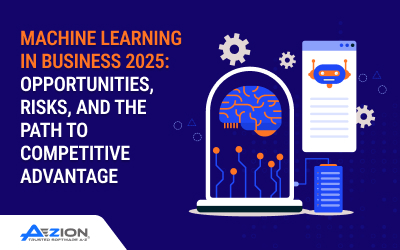
In 2025, Machine Learning has transitioned from an exploratory phase to a phase of becoming a central component of enterprise strategy. The global AI market, fueled mainly through developments in ML, is estimated at around $391 billion today and is predicted to hit $1.81 trillion by 2030, growing at a staggering CAGR of around 35.9%.
In parallel, adoption of AI across businesses has surged. 78% of organizations now use AI in at least one business function, up sharply from 55% just a year earlier. In addition, generative AI—a highly potent class of ML has increased more than two times, growing from 33% in 2023 to 71% in 2024.
Combined, these statistics reflect a turning point. This indicates that Machine Learning is the building block for gaining a competitive edge. Firms remaining on the sidelines are at risk of losing ground to first movers who move ahead with productivity, vision, and strategic responsiveness.
This article explores how Machine Learning is transforming business models in 2025 and what leaders must know to stay competitive.
From Data-Rich to Machine Learning-Driven
Companies now are inundated with information from supply chain records and financial transactions to patient histories and customer interactions. Much of it, however, is collecting dust, more of a historical account than a catalyst for business decisions.
Machine Learning turns that on its head. Instead of relying on static reports or historical evaluations of performance, ML provides living intelligence from raw data predicting future demand, identifying outliers, and recommending next-best actions.
This is more than a technological transition. This is a new method of competition. Organizations that change from data-rich to ML-enhanced operate with vision, speed, and precision; meanwhile, old-school operators are losing efficiency and responsiveness.
Industry Impact: Where Machine Learning is Rewriting the Rules
Machine Learning is not applied in isolation; it is reshaping the operating model of entire industries. Here’s how it is changing the game in the sectors Aezion serves:
Industry | Traditional Approach | Machine Learning Shift |
Logistics & Supply Chain | Static routing, manual planning, and reactive issue handling | Predictive demand forecasting, prescriptive routing, and real-time fleet optimization |
Field Services | Break-fix maintenance, technician dispatch based on availability | Predictive maintenance, optimized workforce scheduling, proactive service delivery |
Finance & Accounting | Periodic audits, rule-based fraud checks, and manual planning | Continuous anomaly detection, intelligent forecasting, ML-driven risk modeling |
Healthcare | Episodic treatment, manual diagnostics, and fragmented patient data | Predictive diagnostics, outcome forecasting, streamlined hospital workflows |
Retail & E-Commerce | Mass promotions, manual stock management | Hyper-personalized offers, dynamic pricing, and demand-based inventory optimization |
Manufacturing | Post-production defect checks, downtime-driven maintenance | Real-time quality assurance, inline defect prevention, predictive process control |
Why Machine Learning Matters for Business Leaders
For business leaders, Machine Learning is no longer a tech talk it’s a boardroom agenda. The return comes in the way ML directly addresses business results:
- Revenue Growth: Intelligent recommendations, pricing optimization, and cross-sell can accelerate top-line performance.
- Cost Savings: Predictive maintenance, routing optimization, and intelligent automation eliminate waste and reduce downtime.
- Risk Management: Continuous monitoring and anomaly detection can raise red flags on issues before they grow into lost costs.
- Customer Experience: Personalization at a scale leads to deeper relationships and increased lifetime value.
- Strategic Agility: Leaders are alerted to change direction quickly due to shifts in market conditions or disruptions.
In short, ML is about recognizing a competitive advantage in a fast-paced environment, where speed, foresight, and precision discriminate the winners.
Common Pitfalls on the ML Journey
Though Machine Learning holds the potential for game-changing returns, many leaders falter in implementation. Common pitfalls are:
- Following Hype Instead of Value: Investing in ML pilots with no direct link to business KPIs will always lead to wasted investment.
- Data Without Discipline: Ineffective data quality, siloed systems, or no governance might discredit ML outcomes.
- Forgetting Change Management: Employees reject devices that they do not understand; adoption will be limited without proper communication and training.
- Scaling Too Late or Too Quickly: While some executives wait far too long after their pilots, others scale too quickly without first showing ROI; either way, it stops momentum.
- Not Thinking About Ethics & Compliance: Any bias in a model, or blind spots in compliance, blind a firm to reputational and financial risk.
Aezion’s Perspective: Getting Machine Learning Right
At Aezion, we’ve seen firsthand that success with Machine Learning is less about tools and more about execution discipline. Our approach emphasizes:
- Goal-Oriented Alignment: Each ML initiative is directly connected to business goals, and not simply technical interest.
- Agile and Test-Driven Approach: Iterative cycles with checkpoints to ensure models evolve with the business and not diverge away.
- Data Integrated Strategy: The full life-cycle of data preparation and aggregation of real-time streams shows the capabilities of trusted intelligence.
- Two-In-The-Box Leadership Model: Equal Responsibilities across client and Aezion teams create alignment, collaboration, responsibility, and transparency.
- Scaled Resources: a global presence with offshore economics gives enterprises the cost advantages along with strategic agility.
Final Thoughts
Machine Learning is the operational foundation of contemporary businesses. Across logistics and healthcare, finance and retail, executives who infuse ML into their plans are already seeing quicker growth, more precise foresight, and greater resilience. Those who wait risk seeing competitors leave them behind.
For business executives, the call to action is clear: break free of pilots and make Machine Learning central to strategy. With a qualified partner and rigorous execution, ML is less about algorithms and more about sustained competitive differentiation.
At Aezion, we help companies make that a reality. Our innovation engineering team is turning data into foresight, foresight into action, and action into quantifiable outcomes.
Ready to discover what Machine Learning can do for your business? Meet the innovation engineers of Aezion.
Frequently Asked Questions:
1) What is the difference between traditional analytics and Machine Learning?
Traditional analytics tell us what happened; Machine Learning tells us what will happen and prescribes action in real time.
2) Which industries are most served by Machine Learning?
Industries with intricate operations and vast data sets, such as logistics, healthcare, finance, manufacturing, and retail, see the most significant benefit from adopting ML.
3) What is the most significant roadblock to the successful adoption of ML?
Bad data quality and insufficient alignment to business goals. Organizations beginning with clean, combined data and well-defined KPIs achieve the quickest ROI.